Task & habit management for freelancers
About
Role
Project type
Duration
Status
Challenge
Freelancers struggle to track time, manage tasks, and pursue personal goals across multiple disconnected tools, creating mental overhead, missed billable hours, and making it difficult to achieve priorities.
Goal
Design a consolidated workspace where tasks, time tracking, and personal goals live together — so freelancers spend less time managing tools and more time doing their best work.
Success metric
Percentage of replacing this system with other tools.
Overview
Role: End-to-end UX. Research · IA · Interaction · Handoff
Target user: Freelancers, designers, devs, consultants
The core tension I was designing against: Mental model mismatch.
This week feels heavy
I can't take more work
I need a light day tomorrow
Tasks
Dates
Streaks
Why this is a strong design problem
High frequency: Daily planning decisions, every single workday
High emotional cost: Stress, guilt and burnout when system breaks down
AI opportunity: Context, prediction, load-aware adaptation
Tasks and deadlines - Notion/to-doist, Asana, clickup
Timelines and client work - Google calendar, mental math
Habit and personal goals - Notes app, streaks, hibitica
Thinking and planning - LLM
Work tasks, life habits, long term goals live in different apps
AI doesn't remember this or connected by default
Habits are tracked separately than workload
Generating plans
Explaining things
Breaking tasks into steps
Tradeoffs between work + habit
Load balancing across clients
Streak preservation under overload
Design decision: The product must hold context AI can't, workload, energy, client commitments- and surface it at the moment of planning.
User research
What I believed and where I was wrong
I assumed freelancers wanted smarter features
Research showed they wanted fewer decisions
The real pain wasn't missing tools, it was the cost of switching between them
Research questions I structured interviews around
How do freelancers actually plan there week?
What triggers a planning session?
When do there systems break down?
What do they abandon and why?
What does "being on top of things" actually feel like for them?
A profile of my ideal customer
Who are my users?
Barriers to adoption
Age
Location
Gender
Career
Disability
Attitudes towards technology & change
Risk tolerance
When they use the product?
Where they use it?
Environmental constraints ( time, budget, tools, regulation)
Trigger events that prompt usage
Device type usage
Who is the end user
Designers, writers, consultants, developers, project managers
Independent creator
Future focus
Content creator
About freelancers ( core problem )
No external structure
Manage multiple clients and timelines
Maintain routines without burnout
Balance deep work, admin work
Avoid context switching
About freelancers ( this is strongest ideal customer profile )
Feel fragmantation pain
Activity search for systems
Are open to AI powered insights
Have higher switching motivation
User persona
Understaning persona: Daily planning decisions, every single workday
I began by deeply understanding the target persona-their goals, challenges and daily routines.
This helped me design with empathy, ensuring the solutions were tailored to real user needs, ultimately improving usability and engagements.
Kishan, the freelancer this is designed for
Age - 30
Profession - Freelancer designer and developer
Location - Kerala, India
Experience - 3 yrs
Worked with early stage startups
8-10 yrs in charted accountancy
Kishan is a designer & developer with a non-linear career path
After nearly a decade in chartered accountancy, he transitioned into startup environments and eventually into independent freelancing.
He currently manages 2 acquired clients through referrals.
His work schedule is inconsistent: some days extend to 8-12 hours, while others are limited to 4 hours.
This variability effects time tracking, billing accuracy and task consistency.
Moderately introverted
More analytical than creative in approach
Operates independently rather than as a team-oriented contributor
Moderately active in execution
Organised rather than messy
Shows relatively high risk tolerance
Using AI tools
Leveraging gen AI to accelerate execution
Building systems that provide small "dopamin wins" for completing tasks
Exploring lightweight productivity workflows
Attempted use of notion , but found it overly general purpose
Seeks a system athat minimizes tab switching and context loss
Tried trello but experience friction in accessibility and workflow
Reduce time spent on repitive workflows
Create a unified system for tracking clients and projects
Improve visibility into time allocation and work output
A simple browser-accessible system (not dependent on switching between multiple apps or tabs)
Clear client wise task tracking with due dates
Minimal setup friction
Centralized storage for context (files, meeting notes, transcripts, links)
Visible timeline and history of work
Saving time
Maintaining clarity in commitments
Avoid-last minute rush
Increasing operational efficiency
Undercharged clients due to inaccurate time tracking
Difficulty maintaining structured task discipline
Inconsistent tracking across multiple clients and projects
Productivity variability driven by energy and interest levels
Alternates between high-intensity work sessiosn and low-output days
Prefers independence in workflow decisions
Values speed and practicality over complex systems
Adopts tools quickly but abandons them if friction arises
MVP scope
Total screens: 14
Core screens: 9
AI-powered views: 5
Post MVP screens: 4+
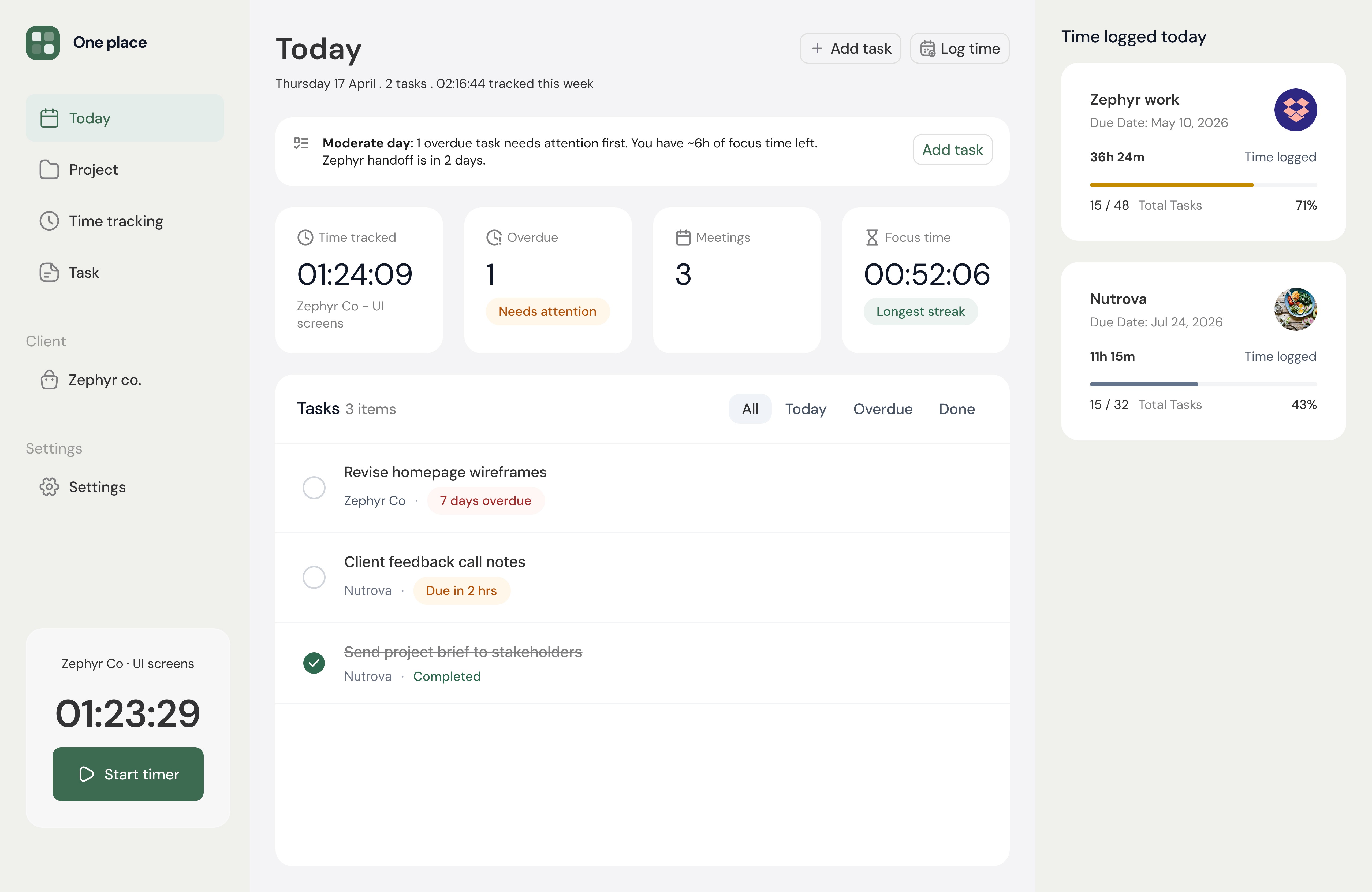
Daily command center
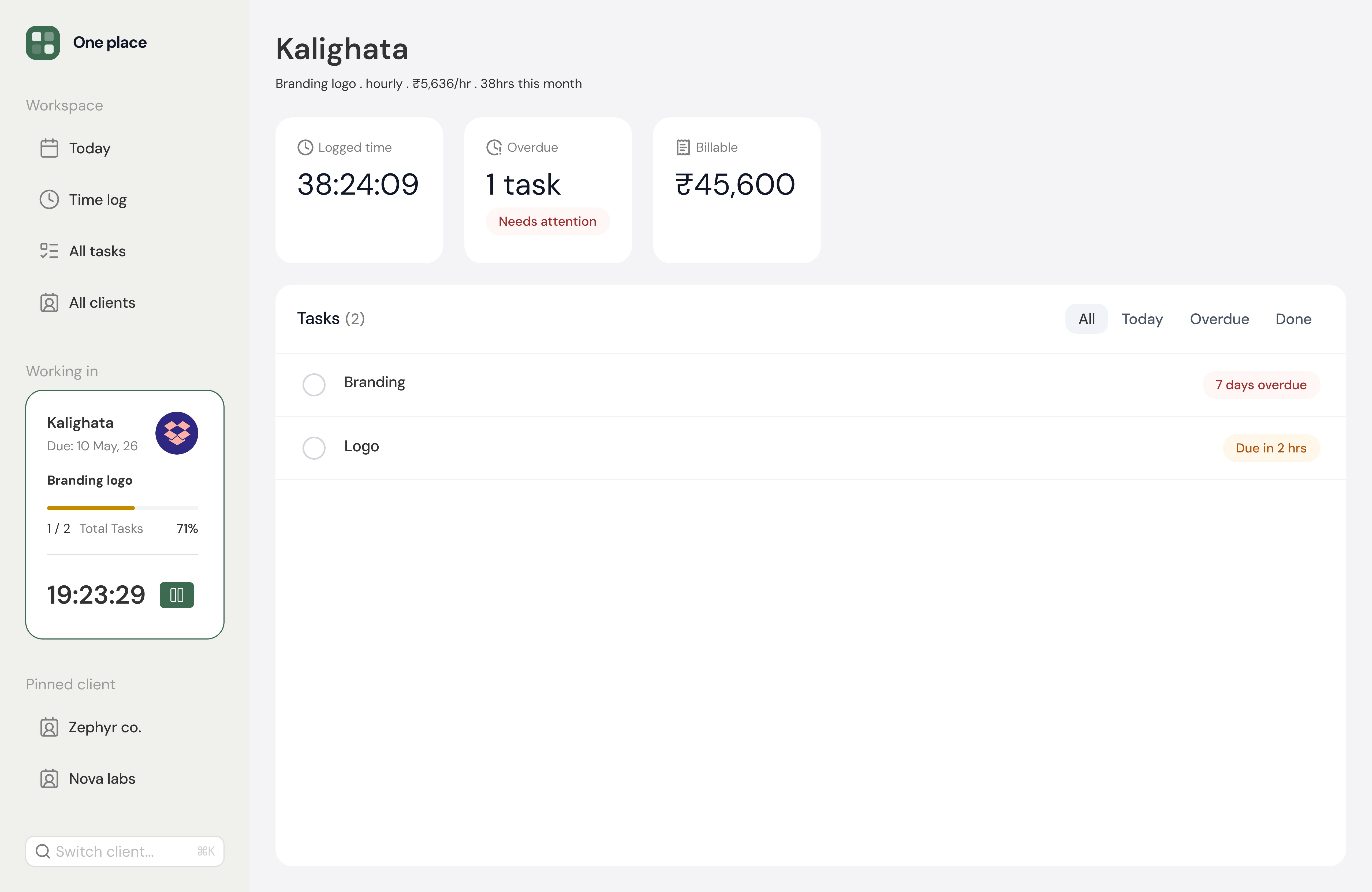
Task due today across all clients, active timer, quick add.
Replaces mental math and tab switching.
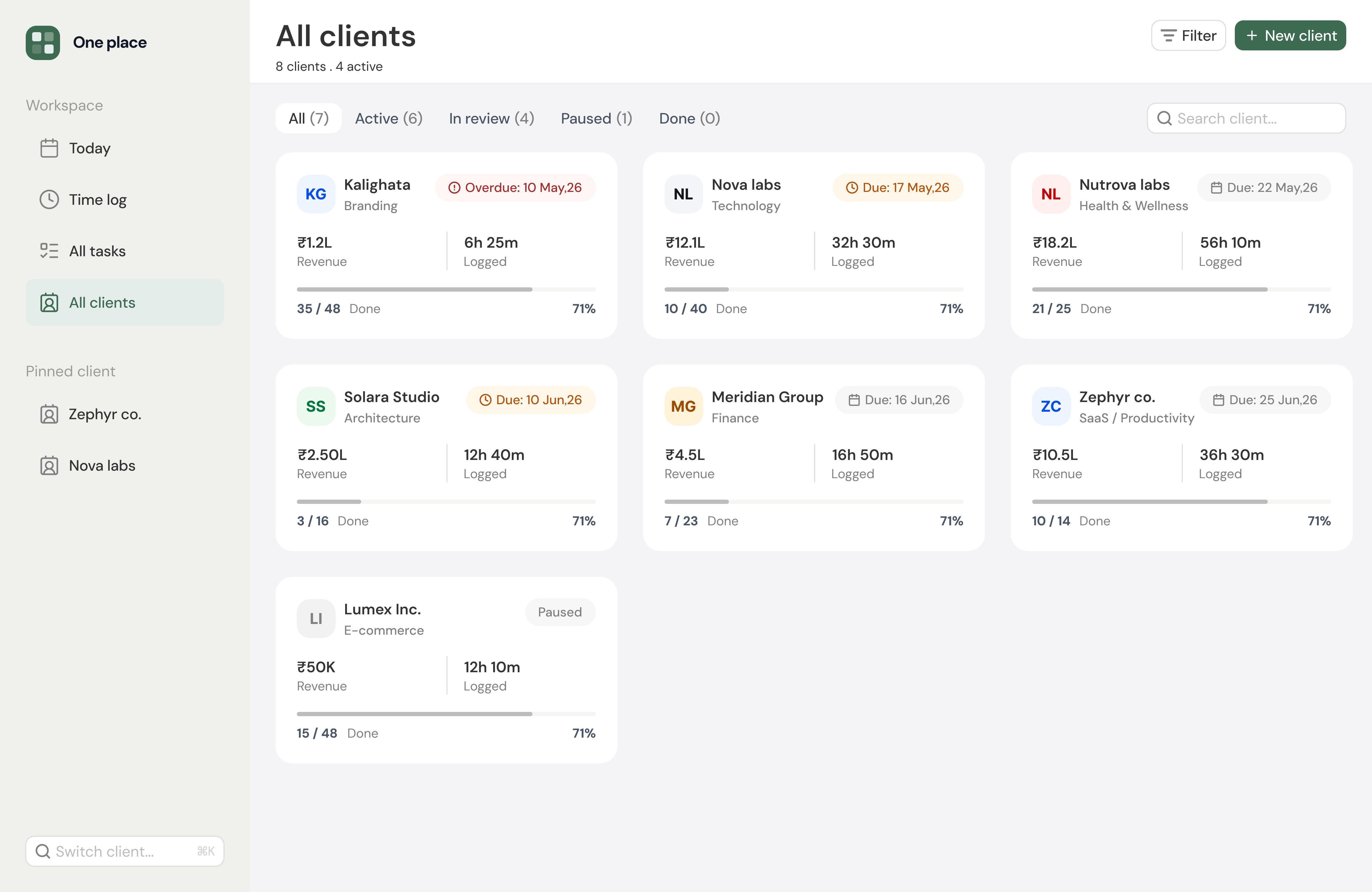
Client and project hub
Client list
Project workspace
Project context AI
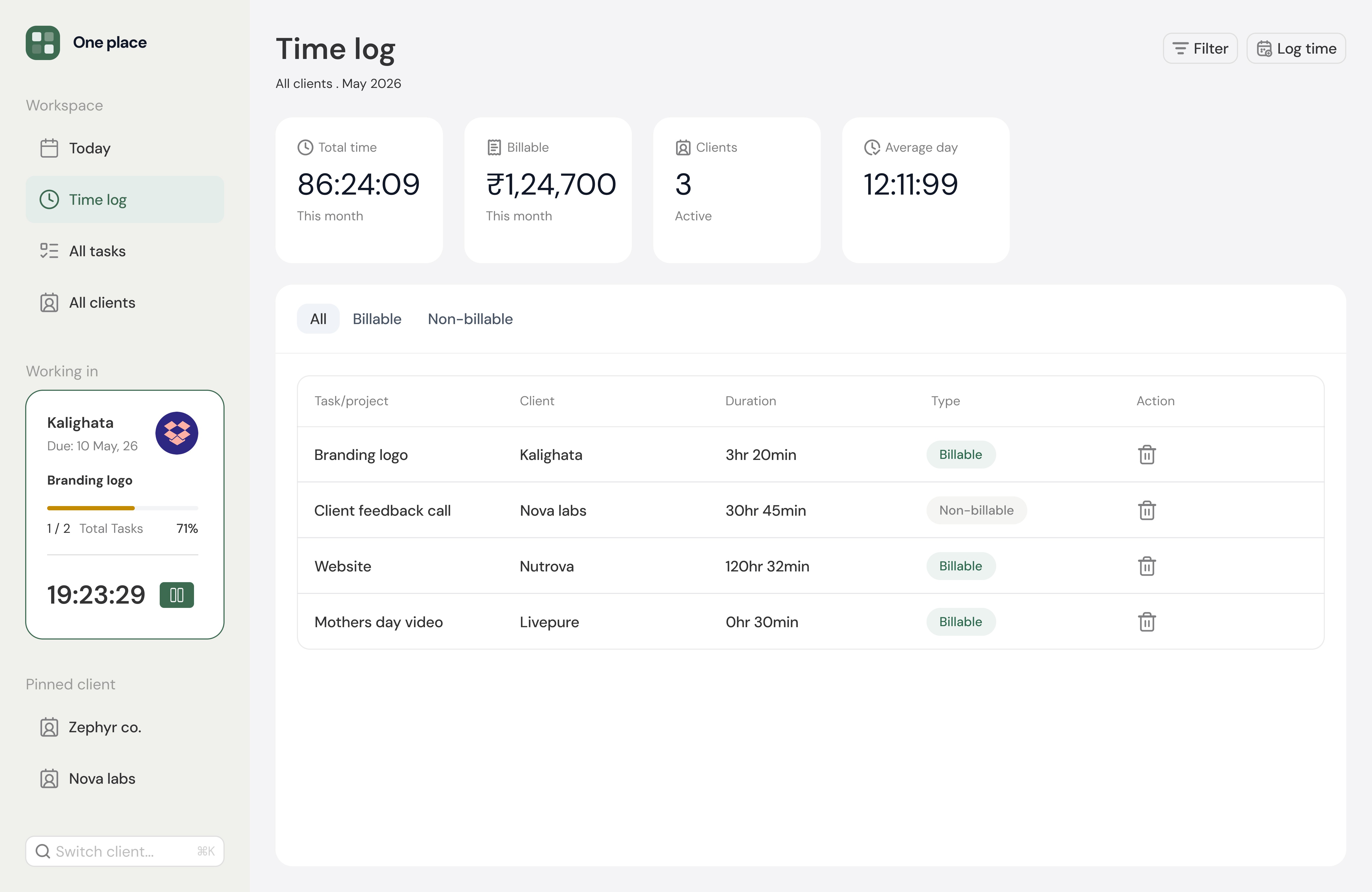
Time tracking
Timer + time log
Billing summary
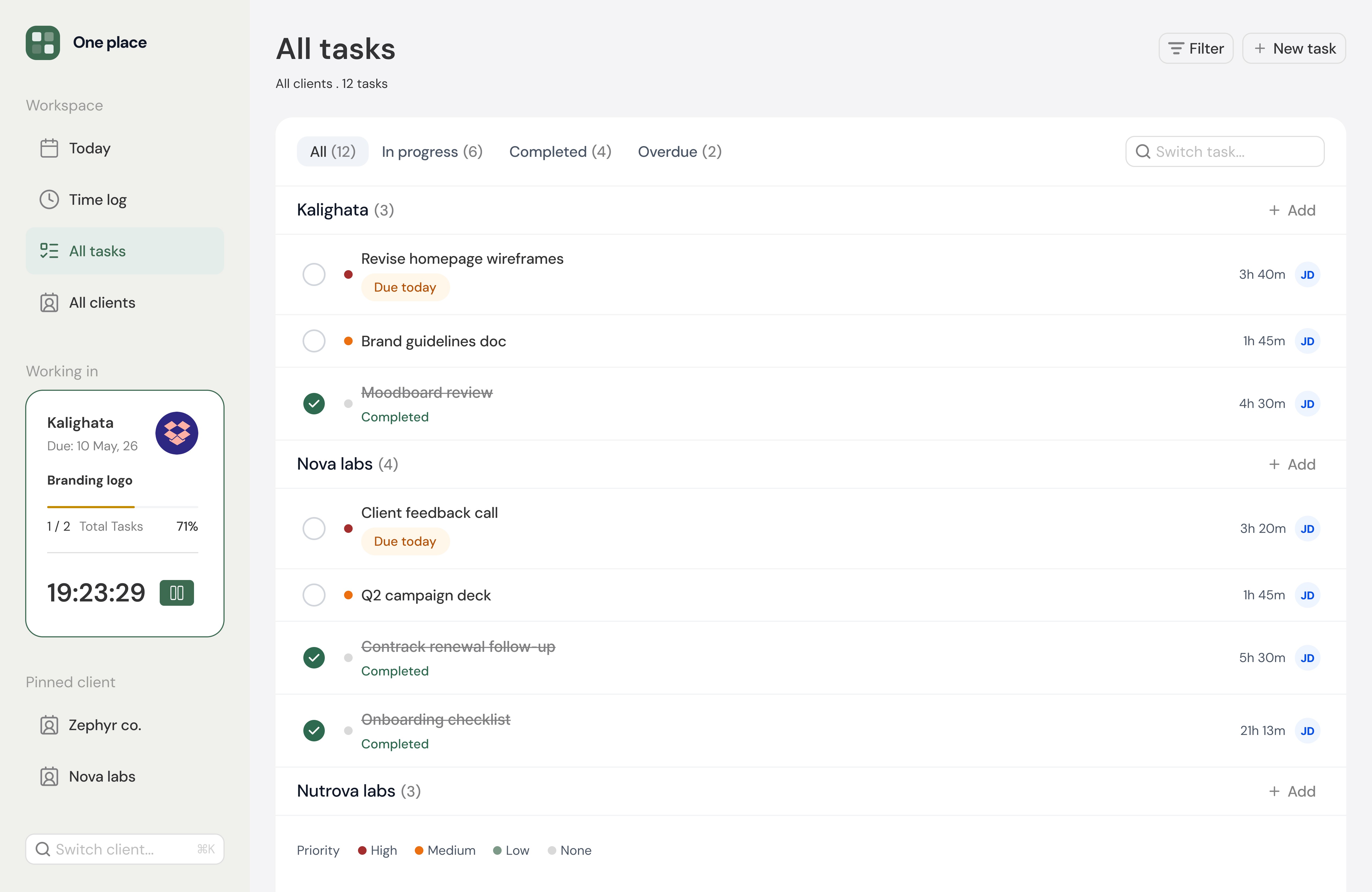
Tasks
Task list ( all projects)
Task detail
AI assistant surface
AI assistant
Weekly summary
Setup & settings
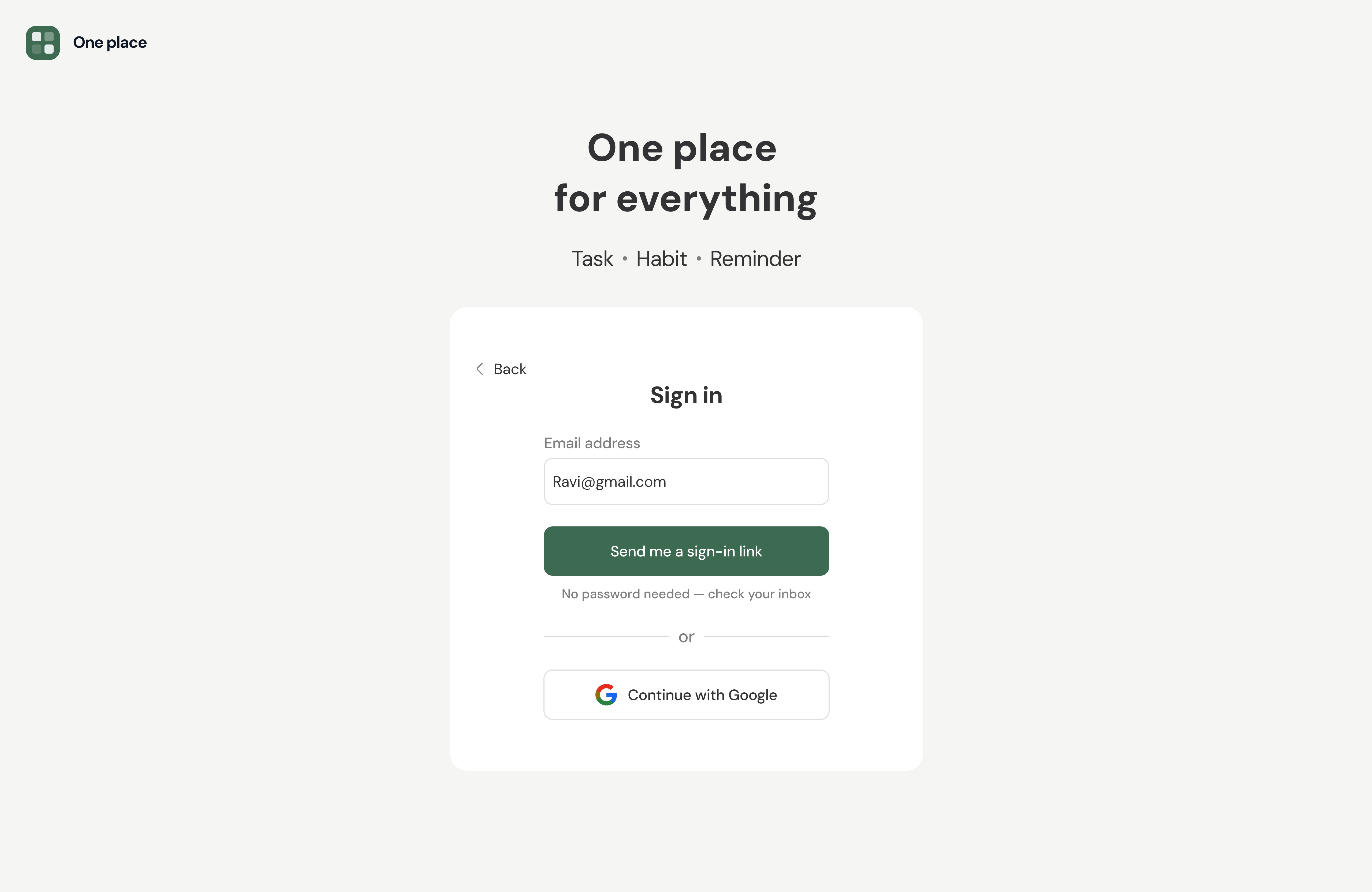
Onboarding/setup
Integrations
Habit tracker
Post MVP
Reports & exports
Knowledge base
Workflow automation
IA decision
Client vs project
Initial instinct was to organize by projects — but research revealed freelancers think in clients, not projects.
However, one client can have multiple active scopes of work with separate deadlines, billing, and progress. A flat client-only structure would collapse that distinction
Design decision: Keep both layers — Client as the primary identity, Project as the work separator for time, invoicing, and progress tracking.